How E.T. increased Reece's Pieces sales by 65% | Nudge Newsletter


Mere Exposure

​Read online​


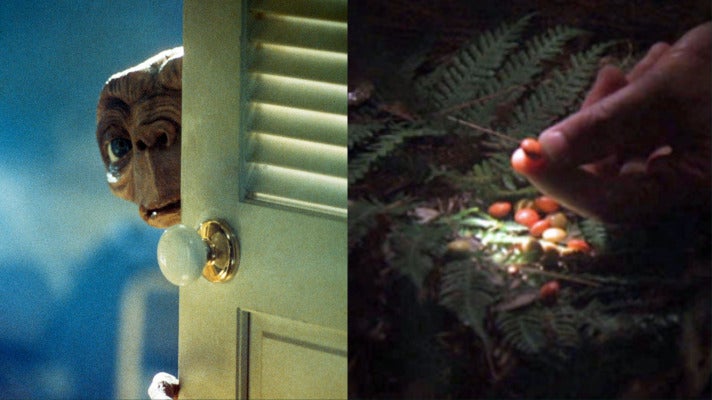
In E.T., director Steven Spielberg planned a scene where the alien creature was coaxed out of hiding using sweets.

Keen not to miss a profitable opportunity, Spielberg approached Mars to use M&M’s for a small fee.

Mars turned Spielberg down.

Undeterred, Spielberg asked Hershey’s for product placement. Hershey’s had just launched Reese’s Pieces, so they jumped at the chance to feature the new chocolates on screen.

After the film premiered in 1982, sales of Reese’s Pieces rose by 65%.

Placing a product on screen directly drove sales.

Or did it?

Perhaps there were other reasons the sales rose. Hershey’s had spent a lot of money on other forms of advertising. Could analysts really link the product success to the blockbuster movie?

Do Product Placements Work?

In 2009, researchers Wiles and Danielova reviewed 126 product placements in dozens of films¹. They measured share prices of the companies producing the product immediately after the film aired.

Turns out, share prices rose by an average of 1% on the day of the film’s premiere.

But why?

E.T. was hardly urging the audience to buy Reece’s Pieces. The characters weren’t commenting on how tasty the peanut snack was. In fact, some buyers would surely be put off by a sweet desired by an alien creature.

Why does seeing the product on screen increase the product's desirability?

Mere Exposure

In 1968, Robert Zajonc published one of the most cited papers in social psychology.² For his study, 72 students were exposed to 12 made-up Turkish words. Zajonc invented words like Jandara, Civadra, and Lokanta to ensure no participant could know their meaning.

Each participant sat with the experimenter, who flashed a card containing one of these made-up words in front of the participant for two seconds.

The experimenter then pronounced the word out loud and asked the participant to verbally repeat it. Some participants saw the same word repeatedly (up to 25 times); others saw the same word only once or twice.

Then, Zajonc told a small lie to each participant. He said the Turkish words were real and that they either meant something good or bad. Participants were asked to rate the words’ ‘goodness’ on a 7-point scale.

Turns out, the ratings of goodness rose in line with the number of exposures. Participants who reviewed the made-up word Jandara rated it roughly 48% higher if they’d been exposed to it 25 times, compared to those who had seen the word just once before.

The more we’re exposed to something, the more we like it.

Seeing a chocolate snack on screen will make you want it more. Even if you don’t remember seeing it.

Cheers,

​Phill​

P.S. I've just finished Alex Edmans' brilliant book The Madness of Markets, which is where I got the idea for this newsletter. Check out his book here.

As a behavioural science practitioner, I believe in the peak-end rule.

¹Wiles, M. A., & Danielova, A. (2009). The worth of product placement in successful films: An event study analysis. Journal of Marketing, 73(4), 44–63.

²Zajonc, R. B. (1968). Attitudinal effects of mere exposure. Journal of Personality and Social Psychology, 9(2, Pt. 2), 1–27.

​Tune into Nudge | Advertise with Nudge | Unsubscribe

Nudge Newsletter

I spend 18 hours each week turning marketing psychology into readable newsletters.

Read more from Nudge Newsletter
Beyond Provocative: How One AI Company's Ad Campaign Betrays Humanity -  Roger Wong

Anchoring Read online In Alex Edmans' great book The Madness of Markets, he writes about how the bookshop Computer Literacy, Inc changed its name. The store, in 1999, became Fatbrain.com. But why? What's wrong with Computer Literacy, Inc? According to Alex Edmans, it was to profit from the dot-com bubble. And it worked. Fatbrain's stock climbed 36% after the name change. A Bloomberg article about the name change. But was the Fatbrain spike in earnings a one-off? To find out, Cooper, Dimitrov...

Concrete Phrases Read online Take a look at this satellite photo. What do you see? Most see a busy Walmart car park. But stock market investors see earnings. RS Metrics sells daily satellite images of parking lots at 44 of the USA’s largest retailers. They photograph 67,000 locations every day (assuming no cloud cover). To a layperson like me, this seems ridiculous. Surely there’s a better metric investors can use to gauge business success? But investors place a high value on these images....

Deep vs Shallow Connections Read online A few weeks back, the world's best-known YouTuber (MrBeast) wrote a book with one of the world's most successful authors (James Patterson). The book is called "The Most Dangerous Games". It creates a fictionalised version of MrBeast's YouTube videos except with more death, romance, and other topics that publishers hope will keep people reading. I'd have wagered a pretty large bet that this book would succeed. James Patterson has sold 425 million books....